
Editor’s note: Every other month, HerbalEGram highlights a conventional food and briefly explores its history, traditional uses, nutritional profile, and modern medicinal research. We also feature a nutritious recipe for an easy-to-prepare dish with each article to encourage readers to experience the extensive benefits of these whole foods. With this series, we hope our readers will gain a newappreciation for the foods they see at the supermarket and frequently include in their diets. We would like to acknowledge ABC Chief Science Officer Stefan Gafner, PhD, and Herbal Gram Associate Editor Hannah Bauman for their contributions to this project.
By Jenny Perez, ABC Education Coordinator
Overview
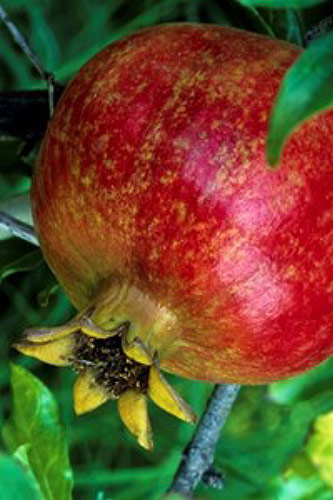
The name pomegranate is derived from the Latin words pomum(“apple”) and granatus (“seeded”), a suitable name for this scarlet red,tough-skinned fruit enclosing edible, juicy arils (seed pulp) which havebeen part of human diets for thousands of years. 1The pomegranateplant is a deciduous, fruit-bearing shrub or small tree that can growup to 25 feet tall. Its glossy green leaves are lance-shaped with smoothmargins and are oppositely arranged on the stem. (1,2) Pomegranateflowers are bright reddish orange and approximately one inch indiameter, with five to eight petals (though cultivated varieties oftenhave more petals). It takes an average of five to eight months forpomegranate fruits to ripen. 3When ripe, the scarlet red fruit is about three to five inches in diameter and nearly round in shape, with thick, reddish skin and a crown-shaped, toothed calyx.(1-4) The number of seeds inside a pomegranate can vary from 200 to 1,400 based on fruit size and variety. An average-sized pomegranate contains approximately 600 seeds, each surrounded by an aril.(1,5-6)
Native to the region of Persia (from Iran to the Himalayan mountainsof northern India), pomegranate is an ancient cultigen that has beencultivated and naturalized throughout the Mediterranean region formore than 5,000 years. 1,7The pomegranate plant can adapt to avariety of climate conditions and is distributed widely throughoutEurasia to the Himalayas. 7Wild pomegranate groves still exist outside abandoned ancient settlements in Georgia and Armenia, which have been dated back to 1000 BCE.1Pomegranates require a long, hot, dry season to produce productive yields of high-quality fruit. Although they can withstand moderate frosts, the plants are prone to root decay and fungal diseases in wetter climates.(1,3)
